
Jung and digital censorship
Archetypes and repression, in modern contexts

*Note: This essay is modified from an original essay written for the Cambridge Jungian Circle’s essay competition (2019). Please excuse the academic prose*
Over the last few million years, evolution has helped humans evolve from simple huntergatherer groups to creating globalized economies and communication networks (Klein, 2017). As we began to form small groups and communities, the hunter-gatherer era saw significant increases in reciprocity and cooperation in our species (Apicell, Marlowe, Fowler, & Christakis, 2012).
Reciprocity cannot exist without communication, and how we communicate with others has radically evolved. Today, we live in a digitally connected world (Allen, 2009), and have the opportunity to hone our talents to benefit society, while living in large organized groups that are becoming increasingly complex (Klein, 2017). Every day, more people have access to affordable smartphone technology, enabling access to a world of information at their fingertips (Pinker, 2018).
We can think of the invention of the internet as a global communication system, where individuals are free to exchange thoughts and dialogue through a plethora of channels with a low barrier to entry (DiMaggio, Hargittai, Neuman, & Robinson, 2001). Importantly, digital censorship is now occurring across major social media platforms (Bowles, 2018; Google, 2018). To what degree does digital censorship have an effect on reciprocity and cooperation? This essay explores this question through Carl Jung’s seminal work on archetypes and the collective unconscious (Jung, 1968).
The only constant is change
Huxley (1965) said, “the world is like a Neapolitan Ice Cream”. He suggests the world includes many layers, such as the biological and social layers. We cannot separate the flavors of the ice cream, but a unifying assumption is that we can find organization at all levels, which follow universal laws.
Bertalanffy (1968) created General Systems Theory to understand these laws. His theory suggests that in a closed system, the end of a system is wholly dependent on the initial starting conditions (e.g. a battery-operated clock). In an open system, the system interacts with its environment, maintaining homeostasis to adapt and survive (e.g. any living organism; Bertalanffy, 1968).
In the evolution of biological complexity, humans are the most complex and adaptive systems discovered thus far (Finlay & Esteban, 2009). Our technological progress exponentiated in the 1960s-70s with the birth of our largest open communication system, the internet (Ryan, 2010).
Bertalanffy’s (1968) theory suggests all systems face complexity and entropy.
Complexity is the degree to which a system grows to adapt to the increasing challenges it faces. Entropy is the natural degree to which systems decay, where things fall from ‘order’ (system) towards ‘chaos’ (non-system) (Peterson, 1999). A closed system will inevitably perish because adaptation is stagnant, but an open system is constantly adapting to complexity as it resists entropy (Gabora, 2017; Bertalanffy, 1968).
Over time, the technology and tools used by humans from small hunter-gatherer groups became better and more specialized for carrying out their purpose (Harle, 1999). Complexity increases in response to increasing demands of the system. For example, increased demand for food brought improvements in hunting and cultivation methods (Chudek, Muthukrishna, & Henrich, 2015). We have also seen the fall of complex systems that became too big to maintain and thus collapse, such as the Roman Empire (White, 2007).
As complexity increases, maintenance becomes important, otherwise the system collapses (Goshert, n.d.).
With complex human social systems evolving over time, communication became integral in building reciprocity, and helping us survive against nature in cohesive groups (Apicell et al., 2012; Finlay & Esteban, 2009; Klein, 2017). When we communicate, we share ideas, build trust with in-group members, and increase social capital, which is the degree to which real-world social networks are intertwined (Chudek et al., 2015; Putnam, Leonardi, & Nanetti, 1994). Shared worldviews lead to shared trust.
A common denominator
Historically, some ideas appear to hold the test of time better than others. This is Jung’s idea of the collective unconscious, which is an abstraction of a fundamental truth that is cross-cultural, having survived for tens of thousands of years (Jung, 1968).
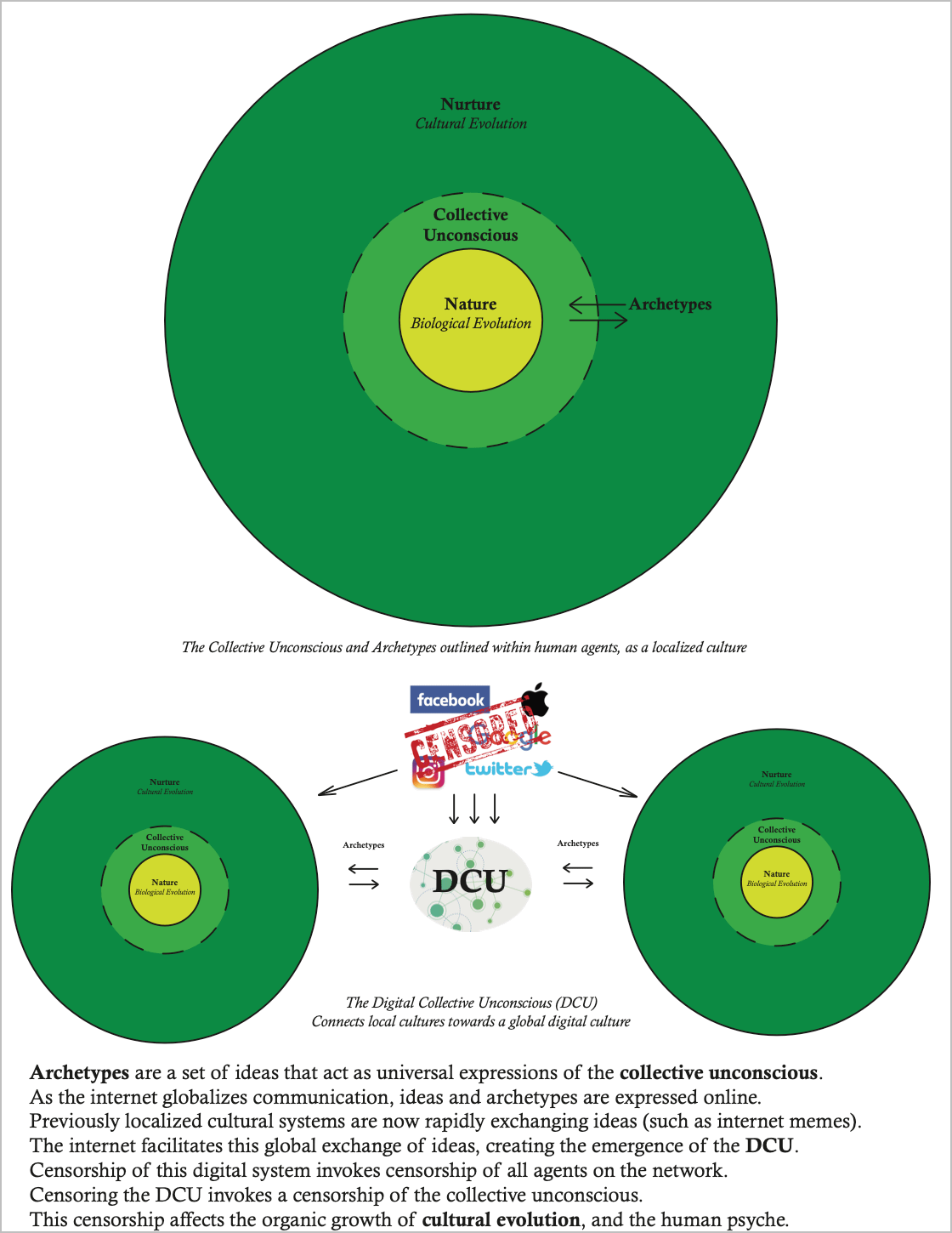
We can think of the collective unconscious as a big cloud. This cloud encapsulates all shared human knowledge that has been passed down across time and culture. We can imagine that fundamental human nature (whatever it may be) situates at the center of the cloud. This is a shared, a priori biological framework from which we understand the world, or nature (biological evolution). Extending from the center is culture, which structures our beliefs, values, and emotions within the environmental context. These concepts surround the center of nature, as nurture (cultural evolution).
Although Jung was raised in a western, educated, industrialized, rich, and democratic sociological structure (WEIRD; Henrich, Heine, & Norenzayan, 2010), evidence for his ideas about archetypical figures can be successfully mapped across time and cultures (Jung, 1968; Peterson, 1999).
In this cloud of ideas, we can think of Jung’s (1968) archetypes, such as the shadow or the wise old man, as representational figures nested in this collective unconscious. These archetypes border nature and nurture in the cloud of knowledge. By discovering a fundamental facet of human nature, Jung bridges a gap between a biological basis of our values and the emergence of cross-cultural ‘meta truths’ identified across different levels of the lived human experience. This explains why archetypal structures have emerged independently across cultures (Jung, 1968; Peterson, 1999; Richter et al., 2016). Jung’s (1968) discovery was the first to articulate universal cultural patterns exhibited by human agents (archetypes), that developed independently across cultures (collective unconscious).
A shifting culture: The DCU
As millions of people log onto the internet every day for the first time, there is emerging assimilation towards a global culture (Pinker, 2018; Stratton, 1997). Where once cultural beliefs, values, and morals would be localized to a small tribe, each individual who communicates in the digital sphere is a part of a new digital collective unconscious (DCU) composed of millions of sub-cultures (Kahn & Kellner, 2003). Here, every interaction is a contribution to this emerging global digital culture. Importantly, every online interaction is a representation of the agents’ inner thoughts. This is partly why digital marketers can learn about our preferences by analyzing our online interactions (Shaw, 2018).
As the world rapidly embraces the digital future (Pinker, 2018), the cloud of human knowledge is digitizing over to ‘the cloud’. Or, the internet. Social media emerged as a trillion-dollar industry in the 21st century, with the help of predictive neural networks (feedback loops), the advertising industry, and our human need to feel connected with others (Dijck, 2013; Editor, 2017).
The drive of advertisers to learn our preferences and biases continuously pushes the boundaries of privacy (Cadwalladr & Graham-Harrison, 2018; Cuthbertson, 2017). Online websites and services know more about us than we know about ourselves (Quenqua, 2015). For example, as a user interacts with a website, the website begins to learn about a user’s preferences. Neural networks predictively display information aligned with the user’s beliefs, while filtering out ‘irrelevant’ information, increasing engagement and user retention (Cadwalladr & Graham-Harrison, 2018).
The longer the user interacts with the site, the more data the website can acquire from the user to learn more about them. This creates a feedback loop for the end user, filtering out information that is incongruent with the set of values held by the agent (user), and presenting them a one-dimensional set of ideas, which is a form of censorship by omission (Editor, 2017).
Just as any system has moving parts, the collective unconscious can be seen as a ‘dance’ between human agents that continuously transacts ideas; correcting, forgetting, or retaining them based on their value to the human system. This interplay of agents at a global scale is parallel to the idea of the extended mind, where the mind is a reciprocal part of the external world (Clark & Chalmers, 1998), or a Gestalt super-organism (Voigt, 2011), which illustrates how group behaviour has a mind of its own (Gordon, 2019). Sharing ideas, feelings, and emotions with others is perhaps the most important function of our survival as a species. Communication increases reciprocity (Apicell et al., 2012), allows for ideas to be tested with large groups (Gabora, 2017), filters bad ideas from good ones (Gabora, 2017), and allows for scientific progress to be made (Jefferson, 2008). This leads to technological advancements, and ultimately human progress (Pinker, 2018).
During hunter-gatherer times, this ‘dance’ (communication) between human agents was typically very localized to one’s cultural group, where social interaction was limited to those physically present. The internet magnifies this ‘dance’ to a global stage. Given that the internet is an open system, nobody owns the internet. It is a decentralized system (Bertalanffy, 1968; Ryan, 2010). The internet has mimicked the philosophy of the capitalist market, in that ideas are freely shared, there is no imposition from an authority, and the barrier to entry is the same for everyone (Foster & McChesney, 2011). However, these ideas have recently been challenged.
The largest social media platform Facebook has been accused of a data breach leading to personality-based profiling of its users, causing turmoil in major events such as the 2016 American Presidential Elections (Cadwalladr & Graham-Harrison, 2018).
The largest online search engine Google has been accused of invading privacy and working on a censored version of its services in China (Google, 2018).
The Federal Communications Commission of America has voted to repeal net neutrality laws, effectively allowing internet service companies to squash competitors and create a barrier to entry in the market (Evans, 2017).
Both Facebook and Google are banning channels and pages that promote ideologies different from their company values, while still retaining a duopoly on internet traffic (Alexa, 2019; Bowles, 2018; Cuthbertson, 2017; Damore, 2017; Google, 2018; Tynan, 2018).
I argue that online censorship fragments the DCU. Meaning, censorship hinders the organic spread of diverse ideas, making it harder for ideas to transact between agents. The range of possible ideas are being restricted and selectively delivered via predictive networks, creating feedback loops that tailor online communication to each individual user (Editor, 2017).
Some suggest these feedback loops contribute to increased rates of online tribalism, belief in pseudoscience, and the creation of politically-charged ideological echo chambers (Campbell, Fletcher, & Greenhill, 2002; Damore, 2017; Kata, 2012; Pringle, 2017). Thus, there is evidence that the global culture of ideas is fragmenting.
A healthy open system is self-sustaining and self-optimizing (Bertalanffy, 1968). Just as our bodies actively maintain homeostasis, we must trust that online communication systems have the capacity to maintain and grow independently. When private corporations impose restrictions on the communication of ideas, it becomes difficult for the system to organically develop adaptive ideas and discard others.
The internet is becoming a central means for human communication (Pinker, 2018). We must be careful with how we censor online activity, as the DCU organically facilitates human interaction on the global system of communication. Thus, censoring online activity invokes censorship of the collective unconscious.
Looking forward
Jung’s (1968) work on archetypes and the collective unconscious uncover fundamental facets of our a priori cultural framework, and human nature. As we have evolved from exchanging ideas in small communities to a global cultural network, the internet has facilitated an open communication system that’s becoming increasingly complex. Archetypes act as a shared framework for cross-cultural communication and understanding. As communication becomes globalized, previously localized cultures will encounter value clashes online, but will eventually assimilate into the global culture as ideas are shared and integrated (Stratton, 1997).
Our knowledge of archetypes can be applied to create stories and emphasize shared values within the fragmenting cultural ecosphere, helping foster global group cohesion in the evolving digital social system.
If the collective unconscious is transitioning towards a DCU, we must be careful with how regulation, censorship, and feedback loops are shaping and fragmenting the digital world and human psyche.
The collective unconscious bidirectionally feeds the DCU.
Thus, censoring online activity can be seen as a censoring of the collective cultural mind. Censorship also inhibits idea-exchange across multiple dimensions of thought, contaminating human cultural evolution.
As the internet assimilates towards global culture, Jung’s psychoanalytic discoveries of archetypes and the collective unconscious remain relevant in finding common ground, and ultimately maintaining reciprocity and cooperation amongst our species.

References
Alexa. (2019). The top 500 sites on the web. Retrieved January 2, 2019, from Alexa: https://www.alexa.com/topsites
Apicell, C. L., Marlowe, F. W., Fowler, J. H., & Christakis, N. A. (2012). Social networks and cooperation in hunter-gatherers. Nature, 481, 497-501.
Bertalanffy, L. v. (1968). General System Theory. New York, NY: George Braziller, lnc.
Bowles, N. (2018, December 24). Patreon Bars Anti-Feminist for Racist Speech, Inciting Revolt. Retrieved from The New York Times: https://www.nytimes.com/2018/12/24/technology/patreon-hate-speech-bans.html
Cadwalladr, C., & Graham-Harrison, E. (2018, March 17). Revealed: 50 million Facebook profiles harvested for Cambridge Analytica in major data breach. Retrieved from The Guardian: https://www.theguardian.com/news/2018/mar/17/cambridge-analyticafacebook-influence-us-election
Campbell, J., Fletcher, G., & Greenhill, A. (2002). Tribalism, Conflict and Shape-shifting Identities in Online Communities. Proceedings of the 13th Australasia Conference on Information Systems (pp. 7-9). Melbourne, Australia: Monash University.
Chudek, M., Muthukrishna, M., & Henrich, J. (2015). Cultural Evolution. Retrieved from Joe Henrich - UBC Lab Page: https://www2.psych.ubc.ca/~henrich/pdfs/Chudek_Henrich_cultural_evolution_final.pdf
Clark, A., & Chalmers, D. J. (1998). The Extended Mind. Analysis, 58(1), 7-19.
Cuthbertson, A. (2017, November 2). Who controls the internet? Facebook and Google dominance could cause the 'Death of the Web'. Retrieved from Newsweek: https://www.newsweek.com/facebook-google-internet-traffic-net-neutrality-monopoly-699286
Damore, J. (2017, July). Google’s Ideological Echo Chamber. Retrieved from DocumentCloud: https://assets.documentcloud.org/documents/3914586/Googles-Ideological-Echo-Chamber.pdf
Dijck, J. v. (2013). The culture of connectivity: A critical history of social media. Oxford, England: Oxford University Press.
DiMaggio, P., Hargittai, E., Neuman, W. R., & Robinson, J. P. (2001). Social Implications of the Internet. Annual Review of Sociology, 27, 307-336.
Editor. (2017, February 16). Neural Networks Will Forever Change Advertising and the World. Retrieved from ini0n: http://www.ini0n.com/2017/02/16/neural-networks-will-foreverchange-advertising-and-the-world/
Evans, P. (2017, December 14). FCC votes to roll back U.S. net neutrality protections. Retrieved from CBC: https://www.cbc.ca/news/business/fcc-net-neutrality-1.4448369
Finlay, B. J., & Esteban, G. F. (2009). Can Biological Complexity Be Rationalized? Bioscience, 59(4), 333-340. doi:https://doi.org/10.1525/bio.2009.59.4.11
Foster, J. B., & McChesney, R. W. (2011, March 1). The Internet’s Unholy Marriage to Capitalism. Retrieved from Monthly Review: https://monthlyreview.org/2011/03/01/theinternets-unholy-marriage-to-capitalism/
Gabora, L. (2017). Honing Theory: A Complex Systems Framework for Creativity. Nonlinear Dynamics, Psychology, and Life Sciences, 21(1), 35-88. Retrieved from https://arxiv.org/pdf/1610.02484v1.pdf
Google. (2018, October 10). The Good Censor. Retrieved from Scribd: https://www.scribd.com/document/390521673/The-Good-Censor-GOOGLE-LEAK
Gordon, D. M. (2019, January 2). An ant colony has memories that its individual members don’t have. Retrieved from Big Think: https://bigthink.com/surprising-science/an-ant-colonyhas-memories-that-its-individual-members-dont-have-2624819695
Goshert, T. (n.d.). Applying entropy to maintenance and reliability. Retrieved from Reliable Plant: https://www.reliableplant.com/Read/13584/entropy-maintenance-reliability
Harle, M. (1999). The Rise of Hunter-Gatherer Complexity. Lambda Alpha Journal, 29, 2-11. Retrieved from https://pdfs.semanticscholar.org/e146/d07b657543c73ce1c5a54bcf97c59a9e32e4.pdf
Henrich, J., Heine, S. J., & Norenzayan, A. (2010). The weirdest people in the world? Behavioral and Brain Sciences, 33, 61-83.
Huxley, A. (1965). Brave New World (Reprint ed.). New York, NY: HarperCollins.
Jefferson, R. (2008). Science as Social Enterprise: The CAMBIA BiOS Initiative. In B. Fitzgerald, Legal Framework for e-Research: Realising the Potential (p. 436). Sydney, Australia: Sydney University Press.
Jung, C. G. (1968). The Archetypes and the Collective Unconscious (2 ed.). (R. F. Hull, Trans.) New York, NY: Princeton University Press.
Kahn, R., & Kellner, D. (2003). Internet subcultures and oppositional politics. In D. Muggleton, & R. Weinzierl, The Post-Subcultures Reader (pp. 299-314). Oxford, United Kingdom: Berg Publishers.
Kata, A. (2012). Anti-vaccine activists, Web 2.0, and the postmodern paradigm – An overview of tactics and tropes used online by the anti-vaccination movement. Vaccine, 30(25), 3778-3789.
Klein, R. G. (2017). Language and human evolution. Journal of Neurolinguistics, 43(Part B), 204-221. doi:https://doi.org/10.1016/j.jneuroling.2016.11.004
Peterson, J. B. (1999). Maps of Meaning: The Architecture of Belief. Routledge. Retrieved from https://www.researchgate.net/profile/Jordan_Peterson2/publication/242860067_Maps_of_Meaning_The_Architecture_of_Belief/links/00b7d51cf3676c2f25000000.pdf
Pinker, S. (2018). Enlightenment Now. New York City, New York: Viking.
Pringle, R. (2017, January 24). How the internet is turning us all into 'mean girls'. Retrieved from CBC Opinion: https://www.cbc.ca/news/opinion/new-tribalism-1.3948289
Putnam, R. D., Leonardi, R., & Nanetti, R. Y. (1994). Making Democracy Work: Civic Traditions in Modern Italy. Princeton, New Jersey: Princeton University Press.
Quenqua, D. (2015, January 19). Facebook Knows You Better Than Anyone Else. Retrieved from The New York Times: https://www.nytimes.com/2015/01/20/science/facebook-knowsyou-better-than-anyone-else.html
Richter, N. F., Hauff, S., Schlaegel, C., Gudergan, S., Ringle, C. M., & Gunkel, M. (2016). Using cultural archetypes in cross-cultural management studies. Journal of International Management, 22(1), 63-83.
Ryan, J. (2010). A History of the Internet and the Digital Future. London, England: Reaktion Books Ltd.
Shaw, A. (2018, August 29). Digital Marketing Trends That Are Changing The Way We Market To Consumers. Retrieved from Forbes: https://www.forbes.com/sites/forbescommunicationscouncil/2018/08/29/digitalmarketing-trends-that-are-changing-the-way-we-market-to-consumers
Stratton, J. (1997). Cyberspace and the Globalization of Culture. In D. Porter, Internet Culture (p. 23). New York: Routledge.
Tynan, D. (2018, October 17). Facebook accused of censorship after hundreds of US political pages purged. Retrieved from The Guardian: https://www.theguardian.com/technology/2018/oct/16/facebook-political-activism-pagesinauthentic-behavior-censorship
Voigt, A. (2011). The Rise of Systems Theory in Ecology. In A. Schwarz, & K. Jax, Ecology Revisited: Reflecting on Concepts, Advancing Science (pp. 183-194). Heidelberg, Netherlands: Springer. doi:https://doi.org/10.1007/978-90-481-9744-6_15