
Content
Between hyper-consumption and awareness

Hyper-Stimuli

The White-lined Sphinx Moth (Hyles lineata) are a species of moth evolved to use the moon as a navigational aid during nocturnal flight. With enough evolutionary iterations, they’ve adapted to have sensitive eyes capable of detecting low light levels at night. Like other moth species, the Sphinx Moth tends to be attracted to artificial lights, which means it easily gets distracted at night and instead, finds itself drifting off and seeking man-made light sources.
The term “light pollution” is largely a post-industrial age phenomenon in that only in recent history, humans have become capable of harnessing energy and commercializing it for the commons. Most major cities and towns tend to have some degree of light pollution — street lights, lamp posts, billboards, and urban cityscapes.
Though making the world more safer and visible for humans at night, the mass adoption and rollout of artificial night light overrides the natural light which many nocturnal insects have evolved to adapt its attraction towards. Artificial night light also has quite a disturbing effect on human sleep-wake cycles, and our natural production of hormones like melatonin.
For much of the history of evolution, nearly all biological life has adapted to the rhythms of natural sunlight and moonlight, and insects and humans are no exception. This phenomenon in moths is called phototaxis, which describes how organisms move in response to light sources — either away or towards them.
The exact reason for their attraction to artificial lights is not fully understood but it is believed to be linked to their natural navigation instincts being disrupted by the intensity of artificial light sources. This behavior can sometimes result in the White-lined Sphinx Moths being found in unexpected urban areas, misdirecting its attraction towards artificial light.
Copywriting Needs
One of the things that internet marketers, especially copywriters, really figured out was that we all tend to have the same underlying needs (kind of like Maslow, but for sales).
If the underlying need is recognized or framed to us correctly, acting on the need can trigger an urge to “hit the right button”. This could be by pressing play on the thumbnail of the next YouTube video fed to you by the algorithm, impulse-buying a product online, or getting hooked onto a service or social network that keeps you engaged and makes it hard to close the app, and digitally disconnect.
In subtle ways, you’re being “sold” and gently nudged to act a certain way. If the product is free, your attention and engagement is the hidden cost. Advertisers can make more money if they can get you to engage in pressing the buttons they want you to press. These rather instantaneous series of actions, masked as hyper-optimized skinner boxes, act as a subtle cure to alleviate us from ourselves.
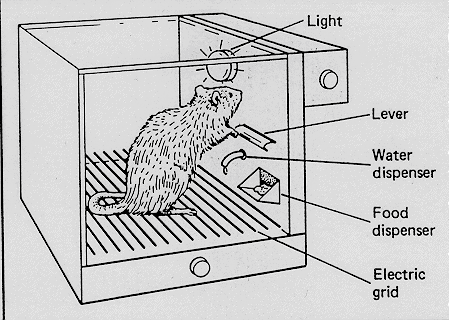
The reality is, modern skinner boxes take many different shapes — that of online shopping pages, copywriting blog posts, clickbait thumbnails, short-form videos, and algorithmic tunneling packaged into an addictive user interface and design, making online content extremely palatable, addictive, captivating, and all-consuming.
Framed this way, it’s easy to see how consuming content can become an emotional escape — a fleeting feeling masked by an acute dopamine hit, followed by a longer-tail of engagement, followed further by an even longer tail of self-disappointment, and even despair.
It’s never one video, one click, one like, one scroll, one tab.
When we’re convinced (perhaps lured) to buy into something, we are master justifiers in that we can post-hoc rationalize our behavior as doing things for ourselves, or for the people in our lives. Even if we’re just doomscrolling or “killing time”, we’re getting something out of it — however meaningless.
Dopamine facilitates strong reward pathways in our brains, and repeatedly engaging in mindless behaviors can can corner us into looping in ways that are very hard to break from. Have you ever closed an app just to feel the pain of reality and instinctually re-open it again without consciously thinking about it?
Copywriters have largely figured out that there are four evergreen types of content, universally relevant topics with endless variations on products that can be pitched and sold to us, regardless of cultural differences: money, health, relationships, and hobbies.
How to earn passive income and retire by 40!
Make Loneliness an option: How to make a new friend this week
Anabolic Shredding: Lose 20 pounds of fat in 20 weeks
Simple Cooking for Simple Chefs - 5 Quick and Healthy Recipes
Just like with Maslow’s hierarchy of needs, these evergreen niches speak to the fact that we ultimately seek out variations of the same thing. We ultimately want to feel safe and secure - both in ourselves, and in relation to others. Finances and wealth accumulation are a means of achieving financial security. Products that can improve our health, promote a better version of ourselves. Relationship advice can help us feel more connected and less lonely.
More niche topics outside of these big three tend to revolve around subcultures and hobbies that reduce boredom, and inadvertently contribute to our needs for money, health, and relationships. For example, the beauty community and make up hobbyists lean on buying/promoting beauty products to help one appear more youthful and healthy. Digital worlds fill a sense of camaraderie, sportsmanship, and foster relationships and community around video games or hobbies. Finance bros love talking money and markets, financial security is a major component to feeling safe and secure in a capitalist world.
At the bottom of all of this, we want to be safe. We want to feel seen. We want to feel heard. We want to feel understood. We want to connect. We want to be accepted in society. We want to feel good, both mentally and physically. Our base-level needs are all the same.
Vices like doomscrolling, pornography consumption, online gambling, and shopping addictions can be seen as an amplified hijacking of our underlying base needs to feel good, connected, rewarded, and secure. Our biology is being hacked through our attention, via modern-day skinner boxes.
Consuming Content, Feeling Content
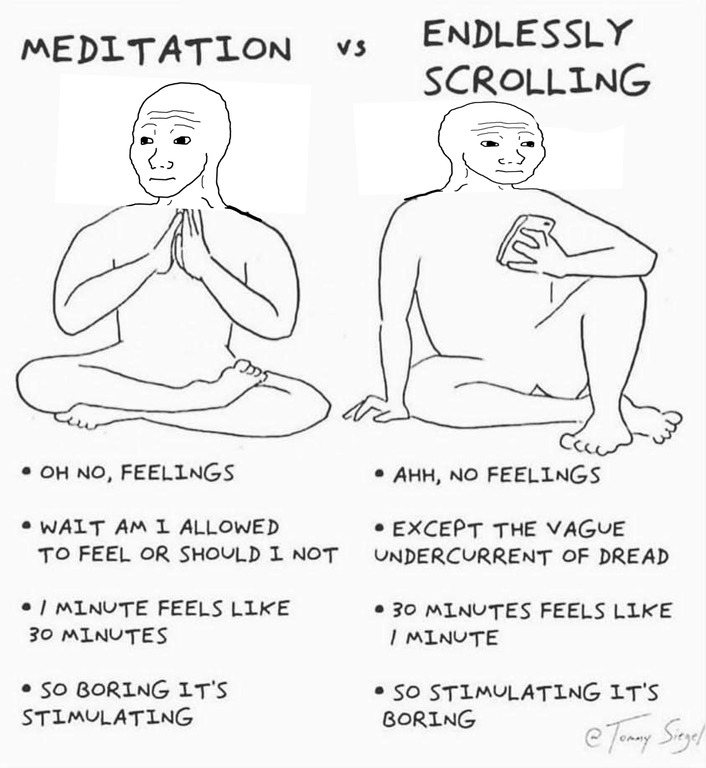
We consume content to feel content, but our neurobiology has been taken over by an elaborate bait-and-switch where the faux stimuli is so good, so convenient, appealing, accessible, and rewarding, that little energy or pleasure comes from pursuit of the real thing.
Organic desire and drive become virtually nonexistent, and we’re left mindlessly consuming more, rather than allowing ourselves to even notice and accept what we are feeling.
Junk food hijacks our tastebuds and reward centers in the brain — an apple tastes less sweet than sugary processed food in the dessert aisle.
Pornography hijacks our sexual desires, attraction — infinite lust leaves little energy for real intimacy, connection, and relationships.
Social media hijacks our need for connection — constant updates and TikToks of faces making eye contact with the camera tricks the mind in feeling “seen”, but passive consumption leads to feeling hollow.
I’m sounding like an old-head ranting about the “good old days” and how things used to be so much “better”… but the homo-memetic-techno-capital machine in many ways can‘t help but double down on hacking and hyper-optimizing any discovered exploit possible.
In doing so, the machine encourages a competitive edge which means whoever can hijack the mind most saliently, gets our attention and wins. This incentivizes the system to have us consume more by learning more about us, forcing us to go deeper, become more addicted, feel more lost and disconnected, and left never feeling fully satisfied.

The same hyper-optima machine is run on the wonderful incentive model of digital advertising. You too can have a way out, if only you buy the right product to help you focus better, live healthier, connect better with people in your life, or hey, maybe check out this cool new hobby or video game! Please keep engaging and don’t leave. We have so much more to learn from you!
Unless you’re an absolute free will denier, you probably believe that to some extent we do have agency as humans. However, it is also equally true that its becoming harder and harder to fight the addictive nature of these systems, which are incentivized by profit to encourage even more consumption, with even stronger hyper-stimuli.
Collectively, we’re left feeling like we’ve lost depth in our relationship with others, with ourselves, and with our own bodies. Our collective attention, cognition, biology, and society is being re-wired by the undercurrent of these strongly engaging and enticing systems. There are rippling effects scaling up from individual to society, with lasting longer-term impacts with unknown long-term consequences, as this is all uncharted territory for humanity.
The street lamp is a man-made technology, invented to improve our vision at night and ultimately aid as a technology to improve our lives for the better. The White-lined Sphinx Moth gets captivated by the street lamp and pulled away by a stronger, artificial stimulus that easily outcompetes the real stimulus it was evolved to follow. Like the moth, we too are being captivated by our own technology, and this hyper-stimuli is distracting us from following our own light.
You Are Unique
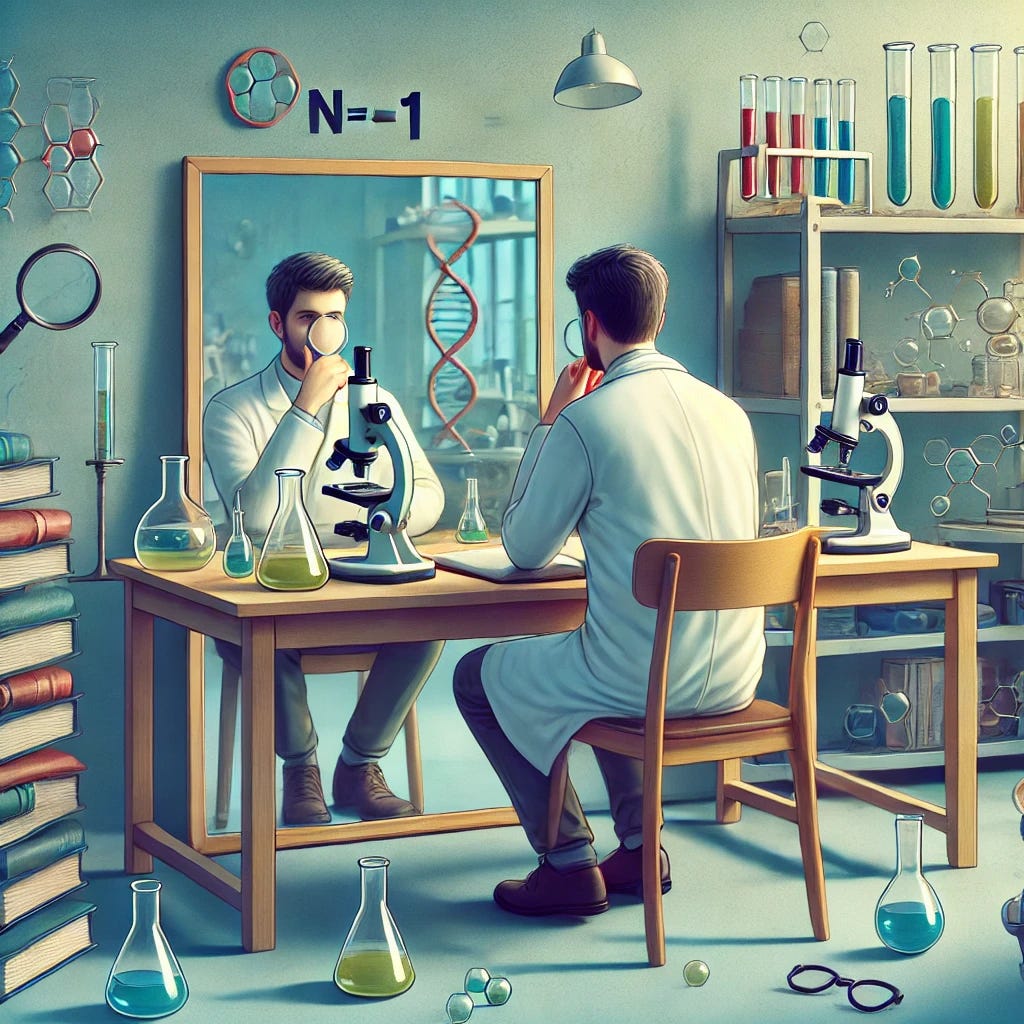
In academic research, n = 1 denotes a selected sample from a given population, whereas N = 1 signifies that one is studying the whole population and not a representation, or biased sample. With n = 1 studies, at best we can infer and try to extract some signal from a study to make an educated guess about how we personally might respond to a specific stimulus or intervention.
If there was a study on sleep disorders in college students with n number of people in the study, and you were trying to learn more about your own sleep habits as a college student trying to improve your sleep, you’re working with a (hopefully) representative sample and seeing if the results align with your own experience. While you never participated in the study, hopefully there’s some helpful data that you can learn, to extrapolate in understanding your own sleep habits.
On the other hand, an N = 1 study means you are both the test subject in the study, and the generalizing population. Anything you find in your own experiment with yourself will directly help in inferring what does and does not work for you — a gold standard of applicability in research.
While we’re all very biologically similar to each other, it’s equally important to note that each person has their own genotypes and phenotypes, personality traits and quirks, which express and manifest in different ways. We are genetically and behaviorally predisposed to different stimuli. Some people are more prone to Type-II diabetes, thus they might get more easily pulled towards overeating. Others might have a natural evolutionary tendency to be good at gathering, but it ends up manifesting into a shopping addiction or hoarding disorder. While we can look at representational studies of n, it’s also just as equally important for us to look inwards at ourselves, as a population of N.

Healthy Self-Inquiry
Systemic issues tend to require systemic interventions. For many of us, we’ve outsourced our wits to the experts — the healthcare system, modern education, government, international organizations — doctors, educators, policy makers… broadly, people in power. While there’s a time and place to call on expertise and there’s no shame in reaching out to get help, we’ve generally lost the ability to cultivate a relationship with our own bodies, and our own selves.
Health influencers have been receiving a resurgence of interest online as of late. Whether its the time-tested, esoteric principa ethica of the likes of Sol Brah, the science-backed principles of modern day protocols promoted by Andrew Huberman, or the future-oriented transhumanist longevity biohackers of Brian Johnson, it seems that health promotion and taking our health in into our own hands has been a sort of reactionary push away from feeling like we’ve lost our own agency in an age where our minds and bodies are constantly being hacked to consume, consume, and consume.
Whether we choose to approach our health from time-tested principals of the past, lean on the modern-day academic protocols of the present, or glimpse into the experimental longevity protocols of the future, all roads lead to Rome.
There has never before been a health revolution where we have both the technology and the available information to take matters into our own hands. Health agency is acknowledging our ancestral biological past, recognizing how we are being hacked in the present, and working towards building resilience and autonomy as sovereign individuals, to shape our future.
This task is not a simple one, and requires that one takes an N = 1 approach to learning and understanding what works best for your body and your mind, and what unique triggers and mental hijacks you are most prone to.
The internet is both a boon and a curse - for all the ways it can try to hack and extract our energy and attention, it also has the gift of giving us the collective knowledge of written human experience. It is not the tool, but what we do with the tool that can lead us feeling frazzled and drowning in content, or intentionally building ourselves up from inside-out towards feeling content in our mind, body, and spirit.

Program or Be Programmed
This sounds almost conspiratorial, but technological advances in the last few years in both virtual/augmented reality (VR/AR) and artificial intelligence (AI) are pointing at the next decade being perhaps the most sinister, or the most agentic time of human history. Another framing is looking at technological advancements through the lens of hardware and software.
Again, I argue that its not the tool, but what we make of the tool that can enhance or captivate our lives. As a basic premise, I argue that VR/AR has the potential to shape our outer world, and AI has the potential to shape our inner world.
Setting the stage here, lets use the example of movies and film. A major blockbuster Hollywood film usually has a cast of a few hundred people, working thousands of hours over many months and years, under the careful orchestration of directors and producers, to ultimately craft a final product.
With movies, everything from the cast selection, clothing choices, camera angle, pacing, background music, dialogue, and setting are thought through with very careful intention. Each frame in a movie has had many hours of deliberation put into it. At any given time, an audience of a few hundred people in a movie theatre go to watch the same crafted experience on the big screen.
When the movie finishes, its common to hear chatter in the theatre’s lobby about people’s favorite parts of the movie. For some, its the visuals. For others, its the actors. Some people loved that one scene! While others felt it was unnecessary or redundant.
Movies are the most carefully crafted experiences, where everyone in the audience is technically experiencing the exact same thing, at the exact same time. However, notice how this very carefully crafted, multi-million dollar experience, left N different impressions for every N number of people seeing the movie!
This speaks to reality bias and lived experiences shaping our meaning making sense for ourselves, and the world around us. No two people are the same, no two experiences are the same. 8 Billion+ people means just as many unique lived experiences and beliefs about how the world works, how one feels in relation to their world, and how we navigate this complex thing called life and the unique challenges we face through this journey.
With increasing enmeshment between human-computer interaction, man and machine, hardware and software, N = 1 algorithms, newsfeeds, and biased perceptions amplify our predispositions and simply give us more of what we want — be it conscious or unconscious.
If we find ourselves consuming a form of content that makes us feel a certain way or biases us to engage more in it, the algorithm just gives us more of it. Over time, computer code scripts machines, and machines promote media, which scripts humans.
Meaning, we are already living a time where code scripts humans. By default, we are being programmed, and by default, man and machine are co-evolving.
Importantly, these powerful tools have the potential to enhance our agency rather than stifle it. We can go from being programmed, to being the programmer of our own experiences.

Externally (Hardware) — The announcement and release of the Apple Vision Pro was a massive boost of legitimacy to the virtual and augmented reality space. While the concept of wearable computers isn’t new, the push by major tech companies entering this space is suggestive that this is the future of computing.
Within the last ~25 years, we’ve gone from having designated computer rooms in our homes where we had to sit down at a specific spot to use a boxy computer to connect online, to having mobile connectivity with portable smartphones, to now having wearable devices that are getting thinner, lighter, and more seamless in our ability to connect and interact with both digital and physical worlds at the same time.
Where movies are carefully crafted experiences and our perceptions and interactions with reality are unique only to ourselves, virtual and augmented reality have the potential to enhance and give us more of what we want to see and interact with, both online and offline.
I don’t see this potential future as a techno-utopia, but more an extrapolation of the already personalized algorithms on our newsfeeds, today. Bias extends from digital to physical worlds.
Sure its possible that we’ll be stuck in some dystopian pod wearing a set of goggles and feeling completely disconnected from our lives and living entirely in a programmed matrix. But also, its possible that we can bring the benefits of being connected to the world and unlock new ways of merging the analogue and the digital, while solving for the problems of hyper-stimuli.
There’s potential to shape our interactions with the world in a conscious way that enhances the individual and collective human experience, rather than distorting and isolating us from it.
Revisiting copywriters and internet marketing, note how the way the internet is currently monetized is largely through digital advertising. Since the dawn of the internet, there has been a counter-movement towards having an advertisement-free internet.
Consider for example, how ad blocking extensions work in your web browser. They are great at blocking ads and annoying popups as we browse, working seamlessly in the background without our conscious awareness or intervention. These browser extensions help to remove something that the internet has default opted into.
By removing ads, we enhance our subjective experience online. Similarly with AR, AI, and other software and hardware advancements, I argue one potentiality is that this evolving technology can metaphorically (and literally) allow us to block “advertisements”, or add anything we want to our perception, in the real world.
A creative Pocari Sweat commercial showing how the physical world and digital world can combine.
Advances in tech allow for a conscious opting in, and out, of ways we experience and interact with the world. We can reject consent for websites to track our cookies and collect our data, but there’s no informed consent around being bombarded by advertisements and subtle behavioral nudges trying to captivate our attention in the real world. These tools have the potential to empower us in programming our lives.

Internally (Software) — Lots can be said here about the potential ups and downsides of AI. To stick to the point of enhancing agency, AI more broadly has the capacity to help you create your own generated content, build your own world, and be your personal support system.
We’ll soon get to a place where a sophisticated model can output uniquely generated songs, shows, or movies tailored to your prompts and inputs! Gone are the days where you’re surfing Netflix for the “right movie or show”. If you know what you want, a model can generate the content uniquely tailored to your consumption needs at any given point. For better or for worse, you’ll have the ability to consciously program the things you consume — they’re literally made by AI, just for you.
Another possibility is training AI as a digital doctor that learns from your health data. A sophisticated AI model can learn so much about you from fitness tracker data, genetic DNA sequencing, your last few blood panels, and ask specific questions about your subjective health state.
Such an AI could provide unique diagnostic capabilities, use face tracking selfie data to learn and give you information on changes to your day-to-day health, and track your inputs and outputs to tell you how a certain lifestyle or dietary change is affecting what is going on in your body.
No doctor or preventative healthcare system today is as capable, or can be personally tailored to your needs. There’s a new possibility here for having internal health sovereignty through conscious programming, with the assistance of AI.
The real world is a combination of the digital world and physical world.
The good comes with the bad, and I’m not shying away from the negatives, but highlighting the duality of this highly possibly future. You thought ideological echo-chambers and biased worldviews were a problem now!
Consider the capacity of malicious intent or bad actors with these tools. There’s ways in which our realities get shaped by giving us more of what we want, but also these systems are more intertwined with our brains and how we interact with the world. What if bad actors play on the fear systems in our brains to bias our beliefs and values? What if these tools unlock new routes to exploit even stronger, more addictive hyper-stimuli?
These tools can be weaponized for real psychological warfare. At the same time, I’m optimistic we’ll have counter-movements with newer and more sophisticated “ad-blockers” that protect us from such attacks, too. Technology ultimately is about enhancing our agency, but this means working against bad actors and being mindful about its implementation in our lives.
A tool can be a weapon in something akin to memetic warfare. Our minds are the “software” and the messaging of the generated media is the “virus”. I don’t believe the answer is some Ted Kaczynski-esque “return to nature” where we destroy all technology and reject everything that is headed our way, but I am highlighting some upside and downside to again hit the message home — we can either consciously program ourselves, or be unconsciously programmed.
The only thing that can save us in this collective enmeshment between man and machine, is our conscious human will. There doesn’t seem to be path backwards from technological evolution and our co-evolution with machines. The traditional monetization paths that rely heavily on data collection and advertisement don’t seem to be going away anytime soon (unless crypto really does solve this). There isn’t a nurturing mother or protective father government, organization, or rule of law that is going to protect your mind from hyper-stimuli.
The only thing we have is our wits, and we must risk everything for our awareness.
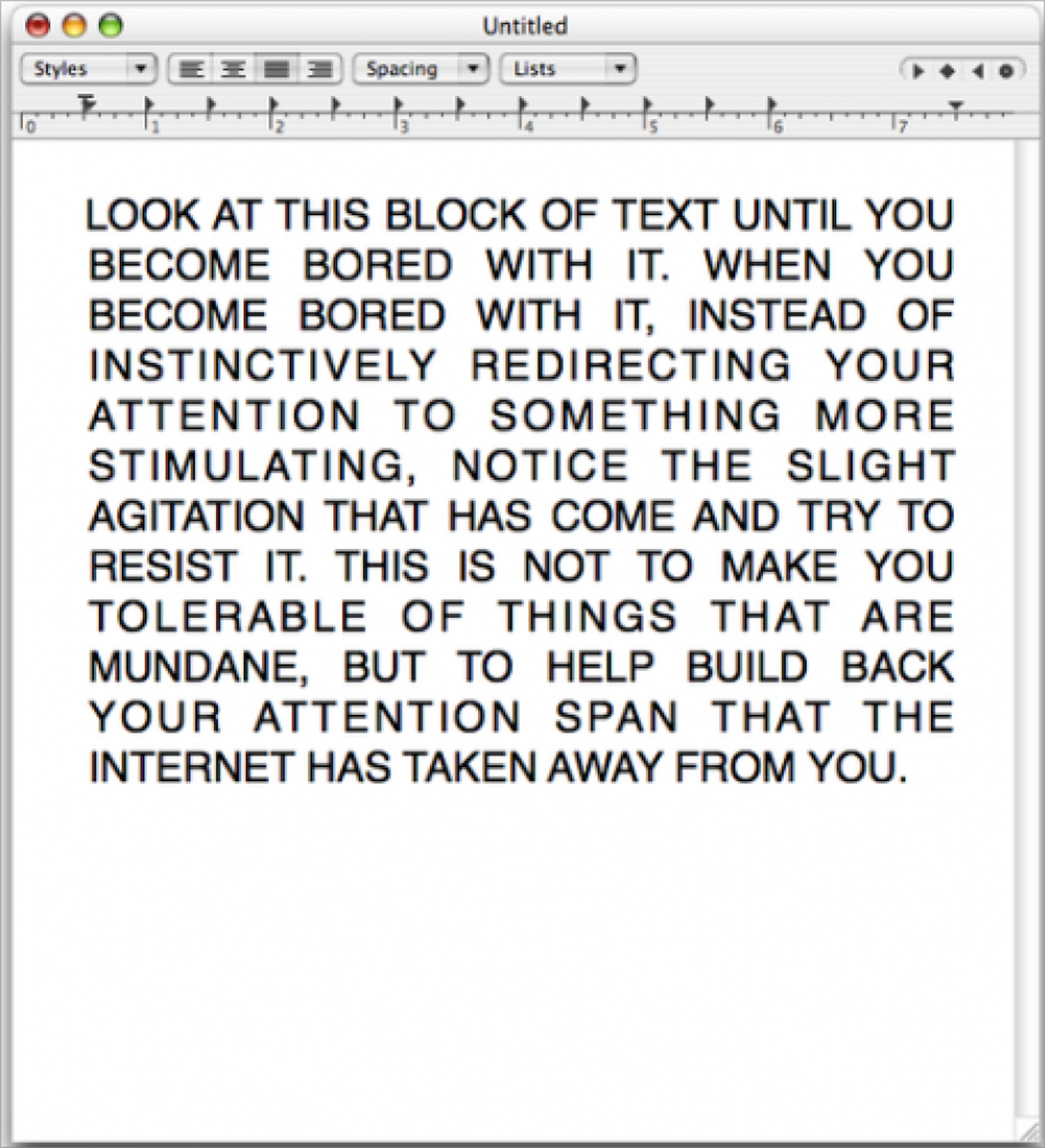
Whether we look at the internet, social media, AI, VR/AR, or any other technologies ripe for cognitive capture and abuse, there is no single answer to our discontentment — why did we end up getting addicted to X instead of Y? How did we end up in this mess in the first place? Focusing on the root of the problem, I believe, is barking up the wrong tree.
The only path forward, is through a conscious meditation on our own truth and doubling down on building systems that align with our inner values, towards absolute awareness.
Only by consciously resisting and being mindful of how we are using these technologies, do we have the capacity to step back and examine what we really want and need from these tools, and understand what is really distraction.
Left below are a series of questions only you, the reader, can honestly answer, and hopefully work through for yourself as you enter the 21st century of the hybrid human-techno machine.
Am I using [tool] to enhance my experience, or am I using [tool] to escape from my experience?
Is it really the tool, or is there something going on with my relationship to the tool?
Does my relationship to the tool tell me anything about my relationship to myself?
What am I running away from? What am I running towards?
What do I need to feel fully present in my experience? Is this being enhanced, or numbed, by engaging with the tool?
What do I gain/lose if I resist the temptation of the tool?
What do I gain/lose from engaging with the tool?
Are parts of my identity tied to my usage or engagement in the tool?
How can these tools help me feel more empowered, and less disempowered?
Is it really a tool for me at this stage in my life, or is it a vice?
Great read. We're definitely writing for the same mission—conscious freedom instead of veering into corporate hijacking of our brains for purposes that aren't our own intention. I appreciated your circling back to the moth analogy in the first third.